
Views: 0 Author: Site Editor Publish Time: 2026-03-11 Origin: Site
In the fresh food industry, preservation is the core pain point that restricts production, distribution, and ultimately impacts product quality. Refrigerated meat discolors, poultry has a short shelf life, and fresh-cut fruits brown quickly—these losses not only erode corporate profits but also diminish the consumer dining experience. While traditional vacuum packaging isolates oxygen, it often leads to juice loss and damaged appearance. Now, Modified Atmosphere Packaging (MAP) technology is redefining the boundaries of freshness, turning the promise of "5x longer shelf life" into reality.
The principle of vacuum packaging is straightforward—remove air to inhibit the growth of aerobic bacteria. However, this "all-or-nothing" approach is not suitable for many fresh foods: red meat turns an unappetizing dark brown due to lack of oxygen, fruits and vegetables accelerate spoilage through anaerobic respiration, and soft products are easily crushed by the pressure of the vacuum.
MAP adopts a more "intelligent" strategy. Instead of simply evacuating, it precisely "replaces" the gas environment inside the package based on the specific characteristics of the food. By mixing oxygen (O₂), carbon dioxide (CO₂), and nitrogen (N₂) in scientifically determined ratios, MAP creates a tailored "microclimate" for each type of food—keeping red meat bright red, putting produce into a "dormant" state, and protecting cooked foods from mold.
The remarkable effectiveness of MAP stems from the synergistic action of its three core gases:
Carbon Dioxide is the Main Antibacterial Agent: It dissolves into the moisture on the food's surface, creating a slightly acidic environment that effectively inhibits the growth of bacteria and mold. Studies show that under low-temperature conditions, high concentrations of CO₂ can extend the shelf life of fresh meat to 7-14 days.
Oxygen is the Guardian of Color: For red meats (beef, pork, lamb), a high-oxygen environment of 70%-80% O₂ maintains the bright red color of myoglobin, which is the primary visual cue consumers use to judge "freshness."
Nitrogen is the Inert Filler: It does not participate in any reactions. Its main role is to balance the internal pressure of the package, prevent collapse, and displace residual oxygen.
Take fresh-cut durian as an example. This climacteric fruit exhibits a sharp increase in respiration rate after cutting, making preservation difficult with traditional methods. By applying precise MAP—controlling oxygen at around 5% and carbon dioxide at 15%—the durian enters a "semi-dormant state," maintaining optimal quality for 12 days under low-temperature storage.
The effectiveness of MAP is not simply a matter of "filling and sealing"; it involves significant technical challenges. Gas flush rate and mixing accuracy are the two core indicators that determine success or failure.
Qualified MAP equipment must guarantee a gas flush rate of over 99.5%—any residual oxygen becomes a breeding ground for microorganisms. Furthermore, the accuracy of the gas mixture must be within ±2% , as different ingredients are extremely sensitive to gas concentrations. For example, the optimal gas ratio for broccoli is O₂ 4-5% and CO₂ 1-2%; too little oxygen causes anaerobic necrosis, while too much fails to slow its respiration rate.
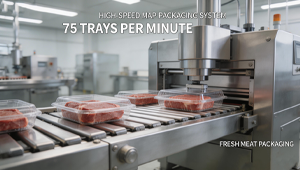
This is precisely the technological barrier that high-end MAP machines overcome. Take industry-leading ultra-high-speed MAP systems as an example. They utilize innovative parallel processing architectures and high-speed servo drive systems, achieving packaging speeds of 75 trays per minute while maintaining precise and stable gas replacement even at high speeds.
In the past, despite its significant benefits, MAP was limited by slow equipment speeds and low automation, failing to meet the demands of industrial-scale production. Today, this bottleneck is being broken.
A new generation of MAP equipment achieves a unity of efficiency and precision. The leap from manual operation to fully automated lines, from 20 trays per minute to 75, has made MAP truly viable for large-scale applications. For food companies, this means not only longer shelf life but also a substantial increase in production capacity—the ability to quickly respond to market demands during peak promotional seasons or large orders.
Simultaneously, the concept of "green ultra-high speed" is becoming an industry trend. By optimizing material utilization and nesting algorithms, advanced equipment significantly reduces energy consumption and material waste per tray while increasing efficiency, helping companies achieve a win-win scenario of economic benefit and environmental responsibility.
The application boundaries of MAP are constantly expanding:
Fresh Meat: Red meats benefit from a high-oxygen mix (70-80% O₂ + 20-30% CO₂), while poultry uses an oxygen-free mix (25-30% CO₂ + 70-75% N₂).
Cooked Meats: A mix of 65-75% N₂ + 25-35% CO₂, combined with stringent pre-packaging sterilization, can extend shelf life to 21 days.
Fresh-Cut Produce: From durian to arbutus, micro-pressure and micro-oxygen techniques put fruit cells into a dormant state, dramatically extending freshness.
Baked Goods: High concentrations of carbon dioxide (30-100%) effectively inhibit mold growth.
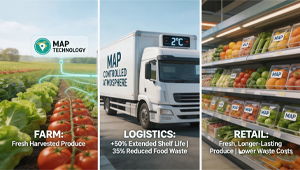
The journey from the "passive defense" of vacuum packaging to the "active control" of Modified Atmosphere Packaging marks a qualitative leap in fresh food preservation technology. When gas ratios can be adjusted to the first decimal place, when packaging speeds exceed 75 trays per minute, and when shelf life extends from days to weeks—this is not merely a technological victory but a fundamental restructuring of the entire food supply chain's efficiency.
For food companies, MAP is no longer an "optional extra" but a core competitive advantage for capturing premium markets and reducing distribution losses. For equipment manufacturers, the companies that master precise gas control, higher packaging speeds, and smarter integrated line solutions will be the ones to seize the initiative in this "freshness revolution."

Address
Jinan,Shandong

Telephone
+86-15098986094


